FIRST PHONE INITIATIVE
Role
CASE STUDY: Unifying the "First Phone" Omnichannel Family Service Ecosystem
Role: Senior Experience Architect & Service Designer
Context: Verizon Consumer Group
Scale: Nationwide rollout across 600+ physical retail stores
Timeline: January 2025 – Present
Core Strengths Utilized: Strategic, Deliberative, Relator, Learner, Responsibility
1. THE CHALLENGE & CONTEXT
Getting a child their first smartphone is a major, emotionally charged milestone for families. While it represents safety and connection, it also introduces deep parental anxiety regarding screen time, digital boundaries, and privacy.
Verizon had several active but highly fragmented family safety features. However, the customer experience was disjointed because product, marketing, and physical retail teams operated in silos. My mandate was to co-lead the "First Phone Experience Vision" alongside the Principal Designer. Our goal was to untangle these disconnected offerings and design a cohesive, trust-based physical-to-digital service ecosystem that would support parents and children through this key lifecycle milestone.
2. DISCOVERY: GROUNDING STRATEGY IN CLIENT RESEARCH
We refused to design this based on internal corporate assumptions. To truly understand parent-child dynamics, we needed primary research.
CMI Collaboration: I co-led child-perspective user research in partnership with our Consumer Market Insights (CMI) team.
Research Stimulation: I authored comprehensive research briefs and initiated interactive "customer case stimuli" to run testing groups with actual parents and children.
Key Insight Synthesized: We uncovered a fundamental human tension: parents demand transparent trust metrics (e.g., location visibility), while children demand respected privacy boundaries. If a safety feature felt too invasive or like "spyware," children would find workarounds, rendering the service useless. To build a successful product, we had to design for mutual trust and respect.
3. THE STRATEGY: A 3-YEAR SERVICE ROADMAP
With these insights, I worked to convert raw qualitative research into a scalable business strategy:
Ecosystem Portfolio Alignment: I co-created a strategic experience framework that prioritized 9 high-impact initiatives for the family segment.
3-Year Roadmap: I mapped out a 3-year product and retail expansion roadmap to align executive leadership on how the family service ecosystem would scale over time.
Stakeholder Alignment: I socialized this long-term experience vision across a massive cross-functional matrix of over a dozen business, product, communications, and CRO Value Proposition teams. I acted as the strategic bridge, aligning disparate product roadmaps around the parent-child trust journey.
4. SERVICE DESIGN EXECUTION: DIGITAL-TO-PHYSICAL COHESION
To deliver a true service design solution, we had to design both the front-stage customer touchpoints and coordinate the backstage operational alignment across digital and physical spaces.
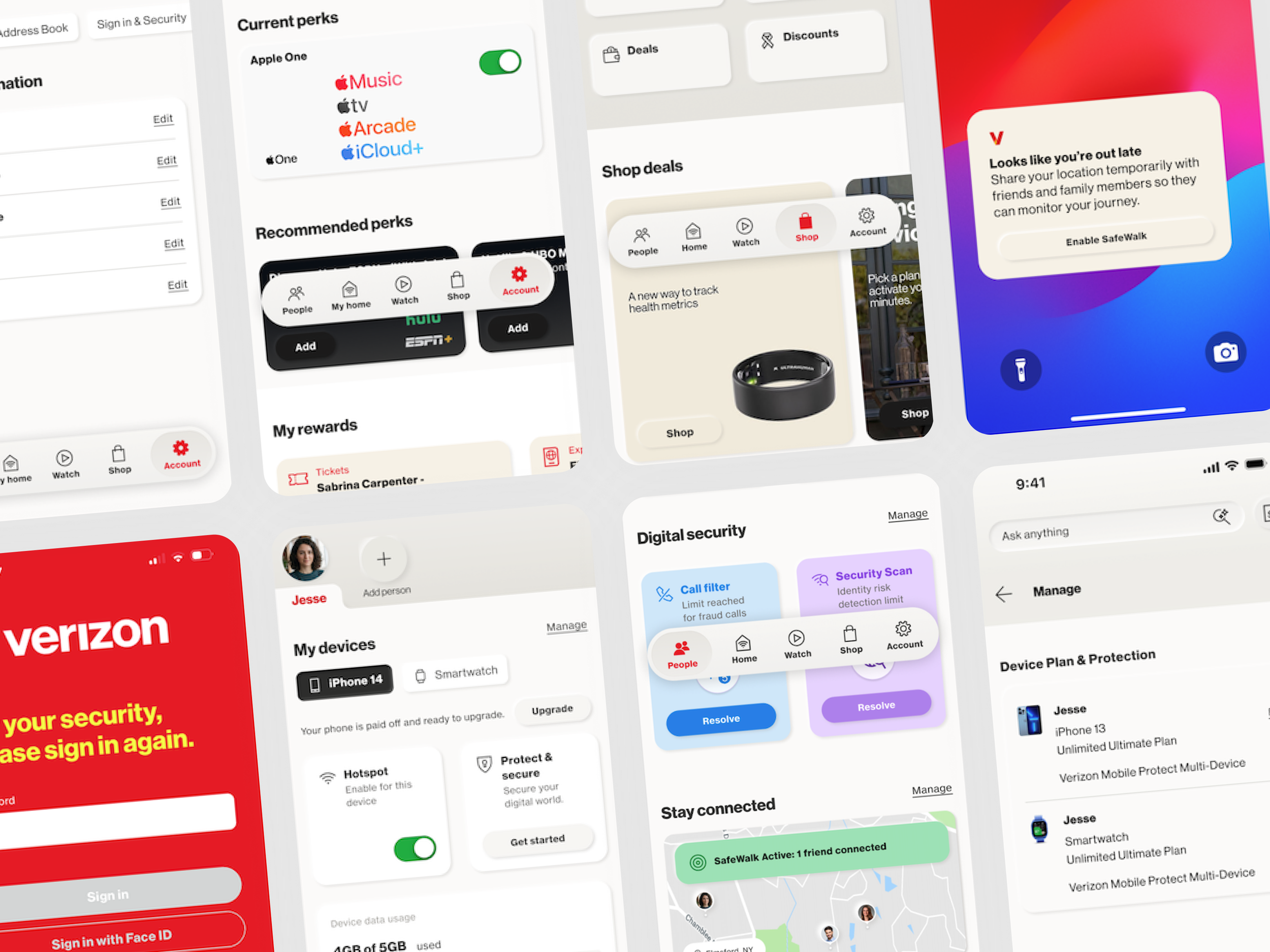
A. Front-Stage Digital Design: Within-Workflow Trust Instead of forcing parents to search for safety features, we designed contextual, "within-workflow" onboarding prompts [Analogus Upsell].
Mutual Pairing UI: Designed an intuitive flow where parents can seamlessly designate a "tracking buddy" and pair devices with their child [Analogus Upsell].
The "Commuter Alert" Toggle: To address child privacy, we introduced a transparent "Commuter Alert" interface [Analogus Upsell]. Instead of parents tracking children silently, the system automatically alerts parents only when a child safely reaches a set destination (like school), respecting the child's independence while giving parents peace of mind [Analogus Upsell].
B. Front-Stage Physical Touchpoint: The "Family Tech Agreement" We identified a critical service gap: the transition from purchasing a phone in-store to setting up parental controls at home was where most customers dropped off.
The Retail Placemat: To bridge this gap, I contributed to the visual design and copy development of a physical retail asset—the "Family Tech Agreement" and Retail Store Placemat.
How it Works: This physical placemat is placed on the retail counter. While waiting for the device to activate, the sales representative guides the family through a cooperative agreement on screen time and safe usage. This transformed a cold, technical transaction into a warm, educational, and memorable family milestone.
5. MEASURABLE BUSINESS & CUSTOMER IMPACT
By combining deep human insights with a rigorous omnichannel design approach, we delivered exceptional results:
Scalable UX Validation: The parent-child trust-based UX models we developed were validated by an outstanding 85% of research participants during CMI testing.
National Scale Rollout: The physical-digital "First Phone Agreement" was successfully launched and was rolled out across more than 600 Verizon retail stores nationwide.
Cross-Functional Unification: Brought together over 12 siloed business and engineering verticals, establishing a unified experience benchmark for how Verizon designs and delivers multi-channel customer strategies.
Role & Impact
Established low-bandwidth purchasing patterns, and aligned 6+ cross-functional teams around a high-congested network solution.
THE PROCESS
The Challenge
When cellular networks become overloaded at packed stadiums or festivals, users experience network failure. Expecting customers to navigate heavy, asset-loaded app interfaces over a degraded network creates a broken user experience.
Friction Points: Heavy web/app pages fail to load precisely when users need to buy speed boosts.
Brand Trust: Charging top-tier unlimited users $5 for functional connection risks optics of a "network tax" unless framed carefully as situational priority.
Technical Constraints: Pass availability had to connect dynamically to 5G Core limits (300k monthly national cap; local cell tower caps).
Architecture & Service Design Frameworks
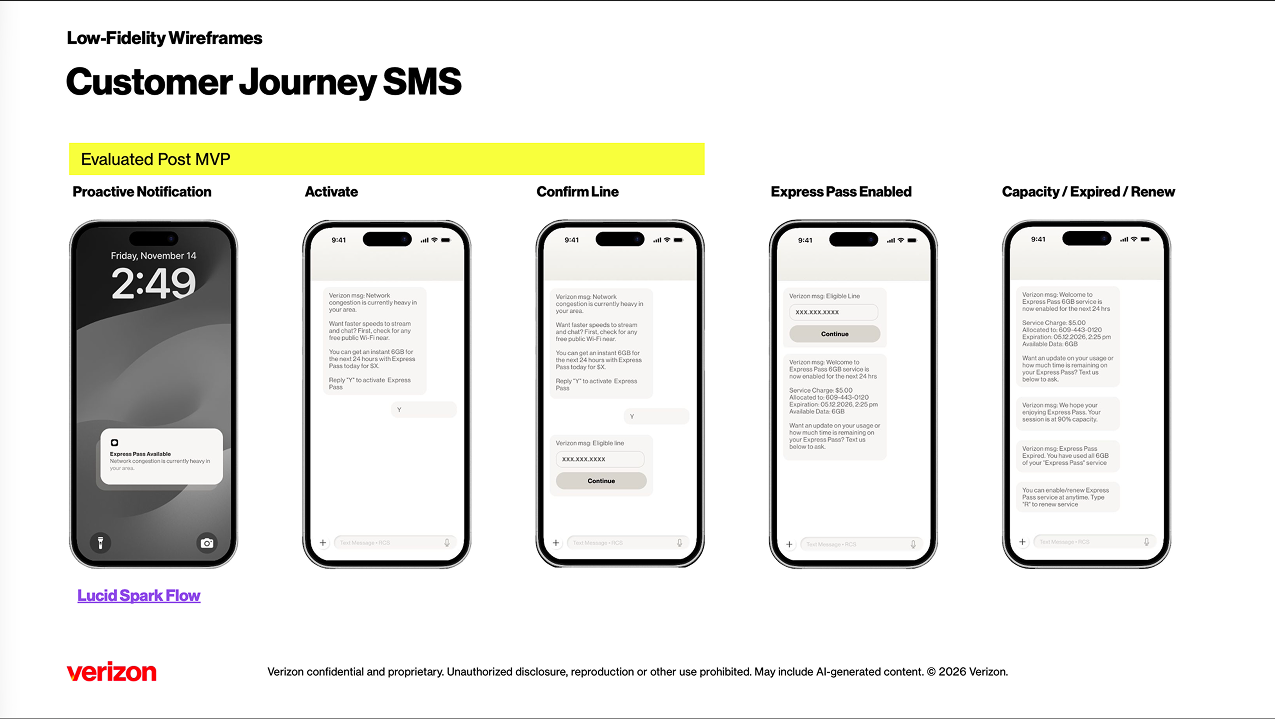
Low-Bandwidth Entry Points: Architected rep-triggered SMS deep links, conversational AI voice/chat flows, and text shortcodes that bypass app/web downloads entirely.
Automated Failure-Rollback: Mapped an edge-case engine where technical provisioning failures automatically trigger a $5 refund and an explanatory text alert, eliminating support calls.
Positioning Metaphor: Partnered with Content Strategy to position the product using an "Express Lane / Police Escort" metaphor rather than a basic network fix.
Lock-Screen Status Workaround: Bypassed 6+ month OEM status bar icon approval cycles by implementing temporary RCS lock-screen push notifications to track 24-hour sessions
Leadership & Systemic Impact
Call Center Deflection: Automated refund routing prevented support escalations for failed network activations
Cross-Functional Blueprint: Authored the master Service Blueprint and CX Team Questions Framework to bridge GTS backend, Storefront, Retail, and Chatbot teams
Scalable Service Pattern: Standardized a reusable low-bandwidth design pattern adopted across the enterprise for future venue and emergency features.
Omnichannel Service Blueprint: System architecture mapping SMS, IVR, Chatbot, and Web touchpoints to backend provisioning APIs
Low-Bandwidth Flow Diagrams: Visual comparison between heavy native app funnels and lightweight SMS checkouts.
PDF
Dynamic PDP UI States: High-fidelity UI showing active purchase states versus "Admission Control / Sold Out" states.
PDF
Research Synthesis & Iteration
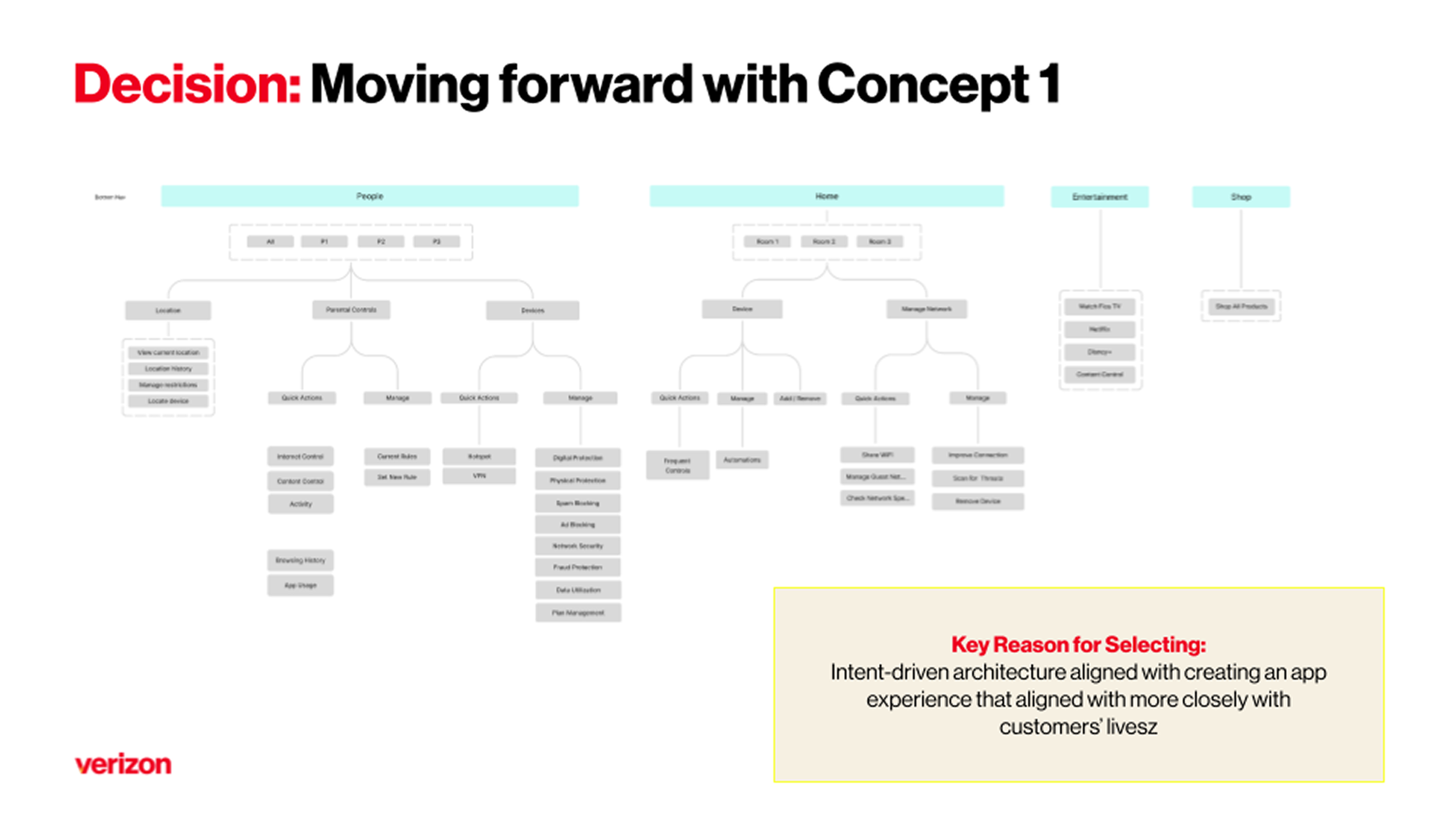
Architectural Stress Testing: Conducted two research rounds evaluating Concept 1 vs. Concept 2. Single-line users felt overwhelmed by family-centric views, prompting dynamic UI adjustments based on account tiers.
User Feedback Summary:
"More modern, streamlined, and cohesive with flat navigation that removes guesswork."
Core Takeaways: While users praised Concept 2’s customized dashboards, Concept 1’s intent-based structure proved far superior for usability, leading to a hybrid model that adopted intent navigation with widget-style customization.
Aligning multi-department business goals required navigating key trade-offs:
Loyalty vs. Screen Real Estate: Product advocated for a top-level Loyalty tab to meet engagement targets. Using research data showing user resistance to transactional tabs in a companion app, I pitched an inline, contextual reward strategy that protected navigation usability while driving higher conversion.
IoT Control vs. Network Management: Business teams wanted a single "Home" hub, but testing showed users separate network setup from smart home control. I led the architectural compromise to unify status views via extensible widgets rather than competing sub-menus.
Business Value & Deliverables
Text